How the Right Box Size Cuts UPS Store Shipping Costs by Up to 20% in 2026
BoxIntel OS Team
22 views
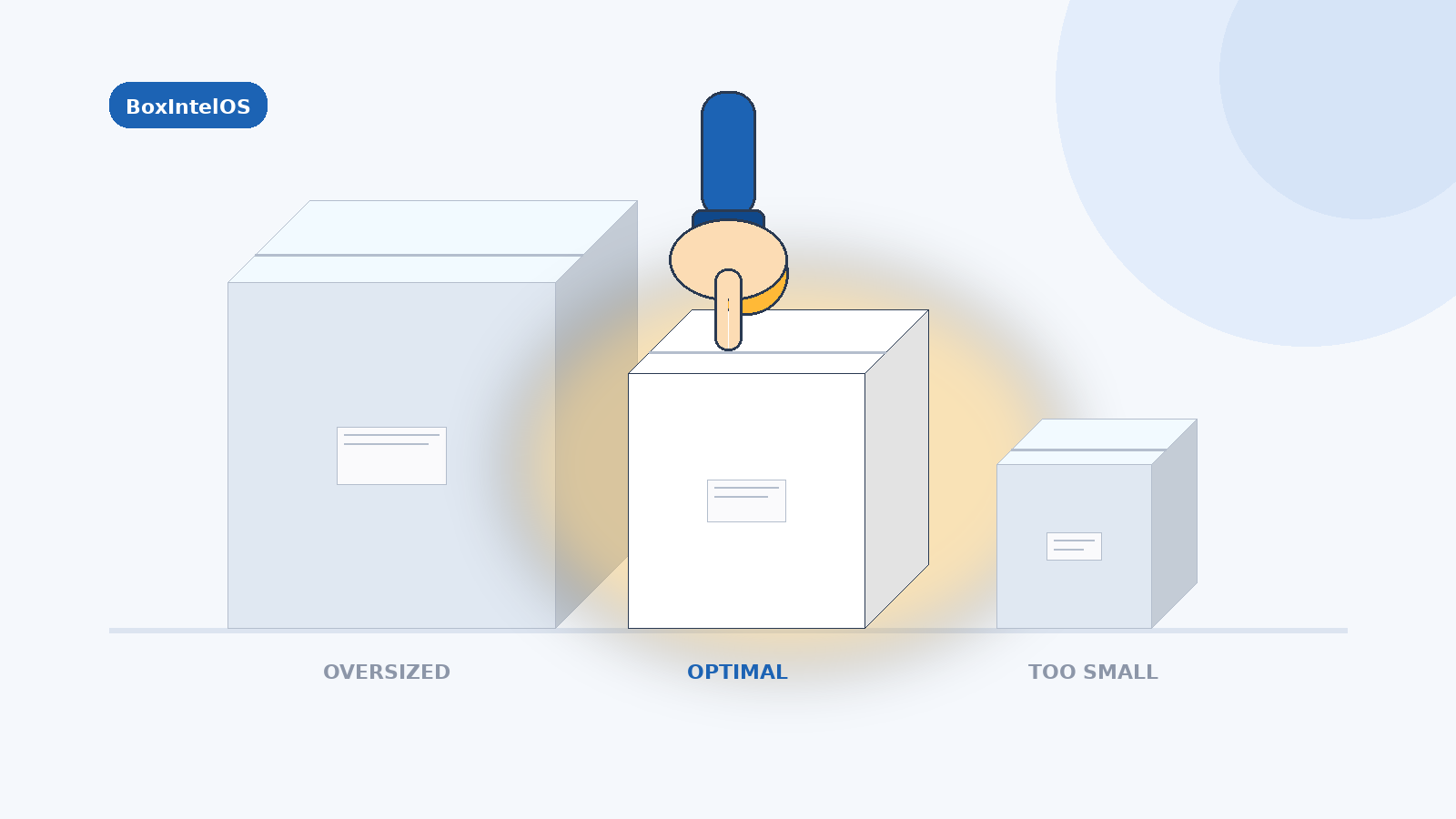
How the Right Box Size Cuts UPS Store Shipping Costs by Up to 20% in 2026
If you own or run a UPS Store, the box you reach for matters more in 2026 than it did a year ago. FedEx and UPS raised published rates by 5.9% this January, and once new surcharges and cubic-volume thresholds are layered on, the real cost impact is closer to 8–12% per package. The single biggest lever most owners still have and the one most teams ignore is picking the right box size for every shipment.
Right-sizing sounds simple. In practice, at a busy counter with a line out the door, your team grabs the closest box that will "probably work" and moves on. Each one of those decisions costs $0.40 to $3.00 in dimensional weight fees that nobody is tracking. Over a year of volume, that's the difference between a store that clears a comfortable margin and one that's always scrambling.
This guide walks through how right-sizing works in 2026, exactly how much it can save, and why packaging software like BoxIntelOS has quietly become a standard at the stores running the cleanest packaging P&L.
What "right box size" actually means in 2026
The "right" box isn't just the one the product fits into. It's the smallest box that:
- Fully protects the item through the UPS network
- Leaves room for the correct amount of void fill (1–2 inches on all sides for fragile goods)
- Minimizes billable dimensional weight
- Avoids triggering Additional Handling or Large Package surcharges
- Comes off your shelf, not a custom order
Miss any one of those and you either lose money or create a damage claim. The math has gotten meaner in 2026. UPS's new Additional Handling surcharge kicks in at 10,368 cubic inches, and the Large Package surcharge now starts at 17,280 cubic inches. A wardrobe box that used to ship clean can now be flagged for an extra $19 to $180 sometimes more than the shipping itself.
Dimensional weight: where your money is actually going
Dimensional (DIM) weight is how carriers charge you for the space a box takes up, not just what it weighs. Since 2022, both UPS and FedEx use a divisor of 139 for domestic packages. Here's the formula every UPS Store owner should have memorized:
Billable weight = MAX( actual weight, (L × W × H) ÷ 139 )
A single example tells the whole story. A 3 lb hand-blown vase packed in a 16 × 12 × 10 inch box has a dimensional weight of (16 × 12 × 10) ÷ 139 = 13.8 lb. You are billed for 14 lb instead of 3 lb on a Ground Zone 5 shipment, that's roughly $12 in pure margin you just handed to the carrier. Multiply that by 40 shipments a day and the number gets ugly fast.
It got worse on August 18, 2025, when UPS and FedEx both began rounding every fractional inch up. A box measured at 11.1 × 8.5 × 6.2 is now billed as 12 × 9 × 7. That single rule pushed average billable weight up about 20% across typical UPS Store mix without you changing a single thing about how you pack. See the full BoxIntelOS breakdown on pricing and surcharge exposure.
How much can right-sizing actually save you?
A Packaging Digest study found box right-sizing alone cuts shipping costs by up to 15%. In UPS Store environments we have modeled with BoxIntelOS, the realized savings ranges from 9% to 22%, depending on mix. Here's the simple breakdown:
- Small-parcel-heavy stores (under 5 lb average): 12–18% shipping cost reduction
- Mixed retail + moving/storage stores: 9–14% reduction
- High-volume eCommerce drop-off stores: 15–22% reduction, because oversize errors compound
On a store doing 1,200 outbound packages a week, a 12% reduction is roughly $72,000 a year of margin recovered. That number should sting if you have not addressed it yet.
💡 Want to see the exact savings for your store volume? Start a free trial of BoxIntelOS it shows you your current DIM exposure within 10 minutes of installation.
Why manual right-sizing fails in a real UPS Store
Every franchisee already knows they should right-size. Very few consistently do. Three reasons:
1. The counter is too fast
At peak hours, your team is juggling pickups, notary appointments, print jobs, and an impatient customer holding a grandmother's clock. Measuring a package, checking a DIM chart, and choosing the optimal SKU takes 90 seconds. Grabbing the nearest box takes 10.
2. DIM charts age out fast
The last printed chart you taped up was probably from 2023. Rate tables, rounding rules, and surcharge thresholds have changed three times since. A chart that's even a quarter out of date is quietly losing you money.
3. Training is the first thing that slips
Turnover at retail service stores runs 40–60% a year. Every time you retrain, consistency drops. The best-packed stores have a system, not a memory.
What a right-sized packaging workflow looks like
The stores running the cleanest packaging operations in 2026 have replaced judgment calls with a simple, three-step workflow:
- Measure once, at intake. Dimensions + weight entered the moment the package reaches the counter.
- System recommends the box. Software cross-references product dimensions against on-shelf SKUs and DIM weight cost.
- Team executes on autopilot. The right box and void fill SKU appear on screen; no debate, no wasted air.
That is the entire BoxIntelOS workflow in one paragraph. Learn more about how the system works and why UPS Store operators who run it stop thinking about DIM weight altogether because the software has already accounted for it.
FAQ: Right box sizing for UPS Store owners
Is right-sizing worth it for low-volume stores?
Yes the percentage savings are the same. A store doing 200 weekly packages still recovers $1,500 to $3,000 a month, which is usually more than the software costs.
Won't my team just override the system when they're in a rush?
They can, but good software logs overrides so you can coach against them. In practice, override rates drop below 5% within the first month because the system is simply faster than guessing.
Does right-sizing increase damage claims?
The opposite. A properly recommended box includes the correct void-fill allowance typically 1 to 2 inches per side for fragile items. Under-packing is almost always a training failure, not a sizing one.
How does BoxIntelOS fit an existing UPS Store POS?
It runs as a counter app alongside your POS. Most stores are live in under 48 hours. See pricing and rollout timelines.
The bottom line
Every shipping rate increase UPS and FedEx announce between now and 2028 is already priced into your operating plan whether you know it or not. The only lever you fully control is the cubic inches you ship. Right-size the box on every package and you can absorb most of those hikes without raising a single customer price.
If you're still doing it by hand, the math is against you. If you're willing to let software handle it, the math flips overnight.
💡 *Start your free trial of BoxIntelOS → and see exactly how much your store is losing to oversized boxes this week.*