How to Train New Employees Faster on Packaging Decisions
BoxIntel OS Team
27 views
How to Train New Employees Faster on Packaging Decisions
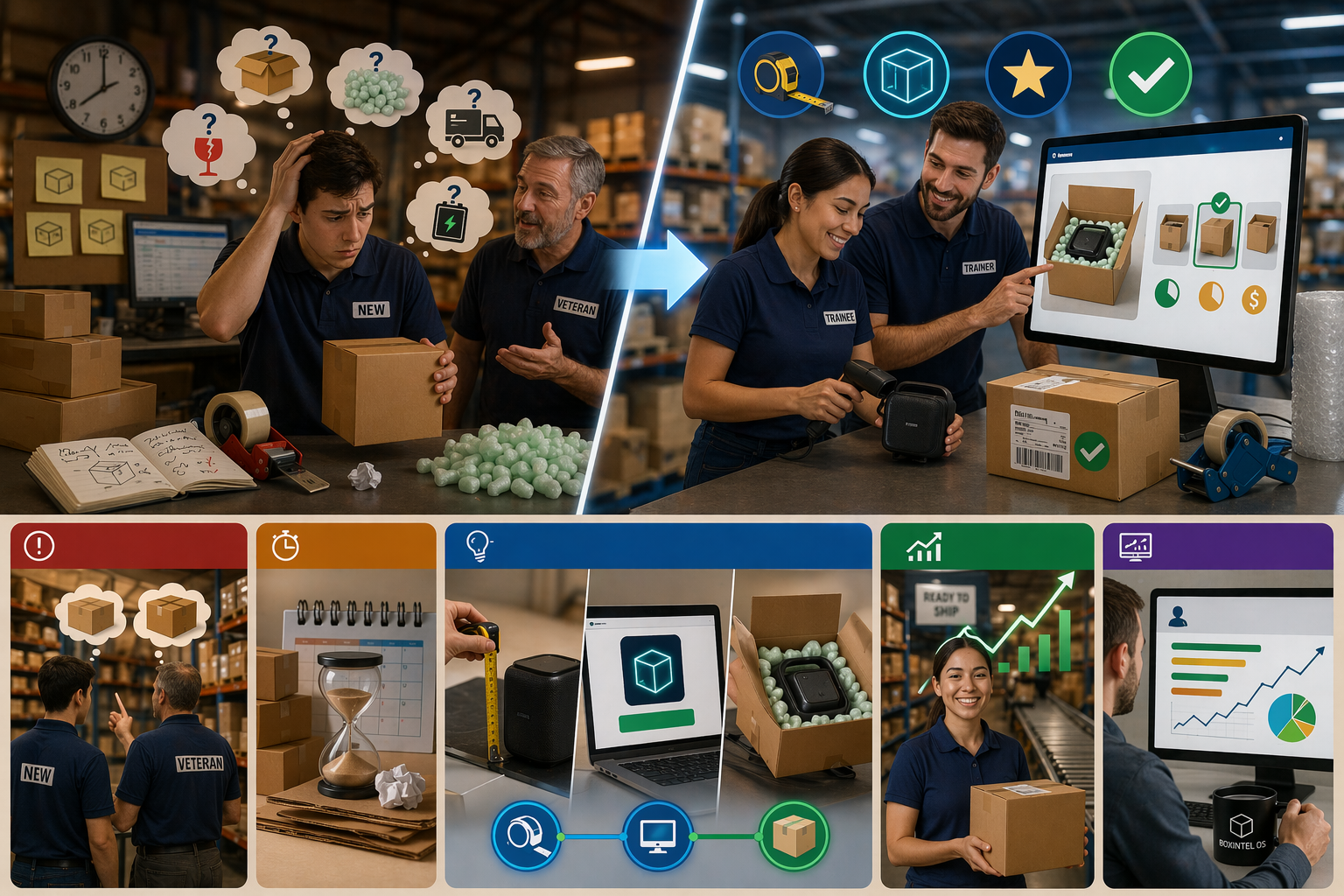
New employees in retail stores and warehouses face a steep learning curve when it comes to packaging. Which box fits this product? Does this item need extra void fill? Is this the right size for this order? Without clear guidance, these decisions get made by feel and that costs money.
Wrong box selection is one of the most persistent and preventable sources of loss in retail shipping operations. BoxIntel OS exists specifically to solve that problem: giving every employee, whether it's their first day or their fifth year, real-time box selection guidance so they never have to guess.
But software alone doesn't replace a smart onboarding process. This guide walks you through how to train new employees faster on packaging decisions and how to make that training stick from day one.
Why Packaging Training Keeps Failing New Employees
Most packaging mistakes aren't employee mistakes. Research shows that 85% of quality errors in warehouse and fulfillment operations are actually attributable to processes and materials, not individual workers. The problem isn't that your new hires are careless it's that they've never been given a reliable, repeatable system for making packaging decisions.
Traditional training approaches look like this:
- A manager walks a new hire through the box inventory once during orientation
- The employee shadows someone for a shift or two and picks it up by watching
- A laminated cheat sheet taped to the packing station covers the most common scenarios
- The rest is learned through trial, error, and asking a coworker
This approach has two fatal weaknesses. First, it doesn't scale. Every new employee requires significant one-on-one time from a senior staff member. Second, the knowledge is fragile. What one experienced employee passes down may differ from what another teaches, creating inconsistency across your team.
The cost compounds fast. Up to 34% of packaging-related returns are caused by damaged products, and replacing a damaged item can cost an e-commerce or retail business up to 17 times the original item cost when you factor in return shipping, restocking, and lost customer trust. Getting packaging decisions right from day one isn't just a training goal it's a financial priority.
What "Fast" Packaging Training Actually Looks Like
Speed in training doesn't mean cutting corners. It means reducing the distance between "new hire" and "confident, consistent decision-maker." That distance is almost always made up of two things: information gaps and confidence gaps.
A new employee who knows the right box for a given product but second-guesses themselves still slows the line. One who grabs the wrong box confidently is even more dangerous. Fast training closes both gaps simultaneously by replacing memory-dependent, person-to-person knowledge transfer with a system that delivers the right answer in the moment.
BoxIntel OS is built around this principle. Rather than requiring employees to memorize a box catalog, the platform provides real-time guidance at the point of decision so the right box choice is always one lookup away, not something that depends on how good the onboarding was last Tuesday.
5 Steps to Train New Employees Faster on Packaging Decisions
1. Separate Product Knowledge from Packaging Knowledge
One of the biggest training mistakes retailers and warehouse managers make is bundling packaging training into general onboarding. New employees are trying to learn the product catalog, store layout, POS systems, and safety procedures simultaneously. Packaging gets 20 minutes and a binder tab.
Treat packaging as its own competency area with its own training session. Even a focused 30-minute block dedicated entirely to how packaging decisions get made and why produces far better retention than scattering it through general onboarding.
When you isolate packaging training, you can also be more precise about what you're actually teaching. There are really only three questions every packaging decision comes down to:
- What is the product's dimensions and fragility?
- What mode of shipping or handling will this go through?
- What is the right box for those two factors?
Everything else is context. Get your new hires confident answering those three questions and the rest follows.
2. Build a Decision Framework, Not a Memorization Exercise
Most packaging cheat sheets are lists. Box sizes, SKU numbers, product names. They require a new employee to scan, match, and remember which works fine for 10 products and fails immediately at 50.
A decision framework is different. It teaches employees how to think, not just what to remember. Instead of "product X goes in box Y," the framework teaches: "If the item is under 12 inches and ships without fragile contents, you're looking at this tier of boxes. If it's fragile or over a certain weight, here's where that logic changes."
This approach has two major advantages. It generalizes across your whole inventory, including products the employee hasn't encountered yet. And it stays accurate when your product mix changes, unlike a static list that goes out of date the moment you add new SKUs.
BoxIntel OS is designed to operationalize exactly this kind of decision logic, surfacing the right box recommendation in real time rather than asking employees to internalize a decision tree from scratch.
3. Put Guidance at the Point of Decision, Not in a Binder
A training manual on a shelf doesn't help an employee who's three seconds away from grabbing the wrong box. The most effective packaging training is contextual, it delivers the right information precisely where and when the decision is being made.
This is why paper-based systems fail under real operational conditions. Even well-intentioned employees skip the reference materials when the floor is busy, when a manager isn't nearby, or when they've made a confident decision that turns out to be wrong. The error often isn't caught until a return comes back.
Point-of-decision guidance, whether through a floor-mounted display, a tablet at the packing station, or a real-time software prompt, removes the friction between knowing something and doing something. BoxIntel OS puts box selection guidance where it belongs: in front of the employee, at the moment they need it, not filed away in an onboarding binder they reviewed three weeks ago.
4. Let New Employees Make Real Decisions Faster (With a Safety Net)
The fastest way to build packaging competency is repetition with immediate feedback. But most training frameworks delay real decision-making for days or weeks, keeping new employees in shadow mode until someone decides they're ready.
The problem with extended shadowing is that it creates passive learners. An employee who watches someone else pack 100 orders has logged 100 observations. An employee who packs 100 orders themselves even with a system to double-check their choices has logged 100 decisions, which is a fundamentally different kind of learning.
A real-time guidance system like BoxIntel OS makes it safe to accelerate this process. New employees can begin making active packaging decisions from their first shift because the system validates their choices in the moment. Mistakes get caught before they become damage claims, not after.
The result is faster competency development, not more risk.
5. Standardize So Turnover Doesn't Reset Your Progress
Retail and warehouse environments have high turnover. That's not a new insight, but it has a direct implication for training: every training investment you make in an individual employee is partially at risk when that person leaves. If your packaging knowledge lives in people's heads, you rebuild it from scratch every time.
Standardization is the antidote. When box selection follows a documented, system-supported process rather than tribal knowledge, a new hire on day one can perform at nearly the same level as a veteran on year three because they're using the same tool, not depending on the same individual.
This is the long-term operational case for a platform like BoxIntel OS. The $19/month investment doesn't just train faster it removes the ceiling on how quickly any new employee can get up to speed, regardless of how experienced their trainer is or how busy the floor is on their first day.
The Hidden Cost of Getting This Wrong
The financial case for better packaging training is not subtle. Consider a single packaging mistake that ships a product in an oversized box:
- The carrier charges dimensional weight pricing, potentially inflating shipping costs
- The product arrives damaged due to movement during transit
- A return is initiated, requiring reverse logistics
- The item must be re-inspected, repacked, and reshipped
- The customer's experience is damaged and they may not return
Multiply that scenario across a team of undertrained new hires during a busy season and the cost is significant. Industry data shows that up to 34% of packaging-related returns result from product damage a category that better box selection decisions can directly reduce.
The flip side is equally compelling. When packaging decisions are made consistently and correctly, dimensional weight costs drop, damage rates fall, and the labor time lost to re-packing errors is recovered. For high-volume retail operations, the ROI on a system that eliminates packaging guesswork often emerges within the first month.
How BoxIntel OS Fits Into Your Training Workflow
BoxIntel OS is packaging software built specifically for retail stores and warehouses. It gives every employee real-time box selection guidance not a manual to read, not a training video to watch, but live decision support at the packing station.
For new employee training, it works like this:
Day one: New hires are oriented on the platform itself, not the entire box inventory. They learn the tool, not the catalog. The tool handles the catalog.
Shifts one through five: Employees use real-time guidance for every packaging decision. They build competency through active doing, not passive observation.
By the end of the first week: Packaging decisions are consistent, confident, and no longer dependent on a nearby senior employee to verify.
BoxIntel OS starts at $19/month with no credit card required to try. For retail stores and warehouses where packaging mistakes are a recurring cost center, that's a straightforward calculation.
Related Resources
If your team handles any specialized shipping categories alongside general retail packaging, these compliance decisions add another layer of training complexity. For example, staff who process consumer electronics orders need to understand when to mark cartons with specific packing instruction codes a topic we cover in detail in When Do You Need to Write PI 966 II or PI 967 II on a Carton?.
Frequently Asked Questions
Q: How long does it realistically take to train a new employee on packaging decisions?
With a traditional shadow-and-memorize approach, most managers report that new employees aren't truly confident with packaging decisions for two to four weeks. With a real-time guidance system in place, that window compresses to a few shifts because employees are making guided decisions from day one rather than waiting until they've memorized enough to go unassisted.
Q: What's the biggest packaging training mistake retail managers make?
Treating packaging training as part of general orientation rather than as a dedicated competency area. When packaging is buried inside a multi-hour onboarding session covering ten other topics, new employees retain very little. A focused session even 30 to 45 minutes combined with a point-of-decision tool produces dramatically better outcomes.
Q: Does a real-time guidance tool make employees dependent on it instead of actually learning?
Not in practice. Employees who use decision-support tools consistently still develop genuine competency over time they just develop it through active repetition rather than memorization. The goal isn't for employees to need the tool forever; it's for them to make fewer mistakes while they're building experience. Many experienced packers continue using the tool not because they need it but because it's faster than doing the mental math themselves.
Q: Can BoxIntel OS work for small retail stores, not just large warehouses?
Yes. The platform was designed specifically for retail stores and warehouses, starting at $19/month. The operational benefits faster training, fewer packaging mistakes, lower shipping costs apply regardless of volume. For smaller operations where one wrong packaging decision has a disproportionate impact, consistent guidance may matter even more.
Q: How do I convince my team to actually use a new packaging tool?
The most effective approach is adoption by design, not mandate. Introduce the tool during onboarding so new employees learn it as the standard way of working rather than as an add-on to an existing habit. For existing staff, frame it as a resource that makes their jobs easier and reduces the frustration of re-packing errors not as a system checking up on them.
Ready to eliminate packaging mistakes and train new employees faster? Try BoxIntel OS free no credit card required.